Heres the Question Again What Did Michael Collins R Us Astronaut Dropped During His Space Walk
Apollo 11: Iv things yous may not know about the outset moon landing
Paradigm source, NASA
Apollo eleven astronaut Michael Collins practises in the simulator in June 1969 - 1 month before launch
Fifty years on, the Apollo Moon programme is probably all the same humankind'due south unmarried greatest technological achievement.
On xvi July 1969, astronauts Neil Armstrong, Buzz Aldrin and Michael Collins were strapped into their Apollo spacecraft on top of the vast Saturn Five rocket and were propelled into orbit in just over eleven minutes. Four days afterward, Armstrong and Aldrin became the first humans to prepare foot on the lunar surface.
Here's a visual guide to four lesser-known facts near the history-making mission.
1. Saturn V is still the largest and most powerful rocket ever built
Continuing at more than 100m (363ft), the Saturn 5 rocket burned some xx tonnes of fuel a second at launch. Propellant accounted for 85% of its overall weight.
"I recall nosotros were all surprised at how strong that thing was," Apollo 8 astronaut Frank Borman said in 2011.
Astronaut Charlie Duke likened the feeling of stage separation - when parts of the spacecraft are jettisoned - to a "railroad train crash".
Interactive: Explore Apollo in 3D
-
Saturn V
Standing more than 100 metres alpine, the Saturn 5 rocket blasted astronauts Armstrong, Aldrin and Collins into space in merely over xi minutes.
-
Lift off
Stage Ane's v rocket engines burned 20 tonnes of kerosene and hydrogen fuel per second to power Apollo to 42 miles above the Earth.
-
2d stage
Stage 2 fired to carry Apollo through the upper temper at a speed of xv,000mph.
-
Beyond Earth
Stage three fired twice - once to get Apollo into orbit - and then again to propel the spacecraft away from Earth towards the moon at a speed of 25,000mph.
-
Apollo
The three astronauts sat in the Command Module. Behind came the Service Module containing engines, fuel tanks and fuel cells.
-
The Lunar Module
The delicate moon landing craft was carried in stage iii, just behind the Control and Service Module.
-
Lunar manoeuvre
Apollo performed a mid-flying flip to dock with the Lunar Module, earlier turning once more and heading toward the Moon.
Paradigm source, NASA
Saturn V: Engineering on a vast scale
Saturn V weighed 2,800 tonnes and generated 34.5m Newtons (seven.7m pounds) of thrust at launch.
That's enough to lift 130 tonnes into World orbit, and transport 43 tonnes to the Moon - the equivalent weight of almost four London buses.
ii. Apollo's crew compartment was nearly the aforementioned size as a large motorcar
Armstrong, Aldrin and Collins spent eight days together travelling most half a million miles to the Moon and back in a space roughly the size of a large car.
The astronauts were strapped into bench-like "couches" during launch and landing in the Control Module, which measured 3.9m (12.8ft) at its widest bespeak.
Information technology was no place for the claustrophobic.
Image source, Getty Images
The Command and Service Module of Apollo 17 pictured from the Lunar Module
Backside the Command Module came the Service Module, which independent fuel tanks and engines.
The Lunar Module (LM or "Lem") was carried in a compartment behind the command and service modules.
The BBC's James Shush takes a look inside the Apollo Command Module
Having left World, Apollo performed a mid-flight plough to dock with the Lunar Module, which was carried into space behind the Command Module, earlier turning again and heading for the Moon.
3. African-American women skilled in maths helped to piece of work out the route to the Moon
Their piece of work processing data and performing complicated calculations was critical to the success of the infinite plan.
Epitome source, NASA
Katherine Johnson, pictured here in 1962, spent 33 years working for Nasa
When the starting time computers appeared, many of Nasa'south early programmers and coders were these women.
The picture Hidden Figures, released in 2016, told the story of these maths wizards, bringing their stories to a mass audition for the kickoff time.
1 woman in particular, Katherine Johnson, became known for her work computing trajectories for the showtime Americans in infinite, Alan Shepard and John Glenn, and afterwards for the Apollo Lunar Module and Control Module on flights to the Moon.
Apollo 11'south flight path took the spacecraft into Earth orbit 11 minutes after launch.
Only over two hours after, during its second orbit, the rocket's third stage fired again to boost Apollo towards the moon - the so-called Trans Lunar Insertion or TLI.
The TLI placed Apollo on a "free-return trajectory" - often illustrated as a figure of eight shape.
This course would have harnessed the ability of the Moon'south gravity to propel the spacecraft dorsum to Earth without the need for more rocket fuel.
However, when Apollo eleven neared its destination, astronauts performed a braking manoeuvre known as "lunar orbit insertion" to slow the spacecraft and crusade it to become into orbit around the Moon.
From there, Armstrong and Aldrin descended to the surface.
four. No-one knows where the Apollo 11 module is at present
A total of 10 lunar modules were sent into space and six landed humans on the moon.
Prototype source, NASA
Apollo 11'south Lunar Module 'Eagle' begins its descent to the lunar surface
Once used, the rise stages of the capsules were jettisoned and either crash-landed on the moon, burned up in Globe'southward atmosphere, or - in one instance - went into orbit effectually the Dominicus.
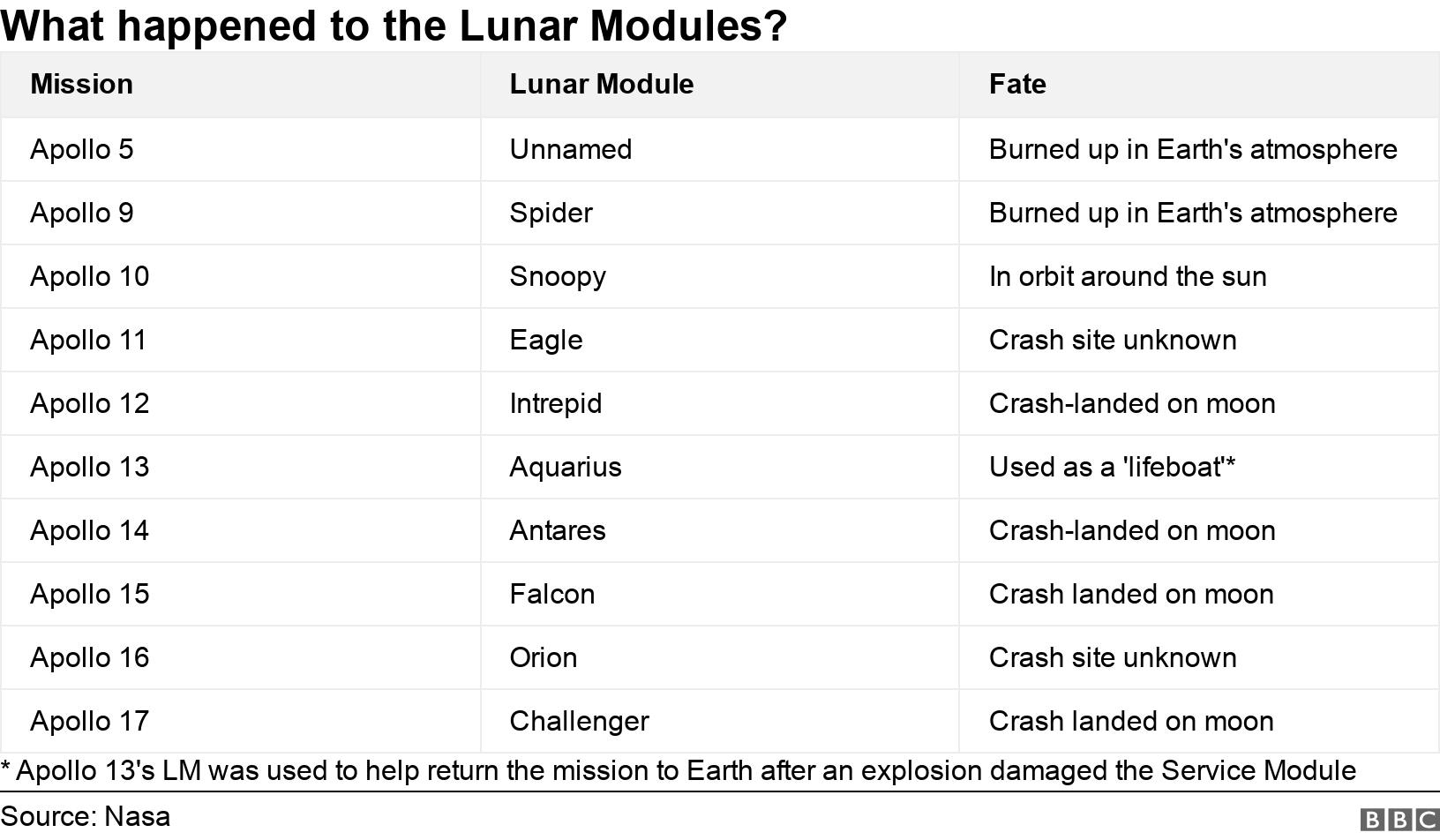
The kickoff two Lunar Modules were used in exam flights and burned up in Earth'southward atmosphere.
Apollo 10's Lunar Module, which went to the Moon merely didn't land, was jettisoned into space and went into orbit effectually the Sun.
Apollo xiii's Lunar Module performed a vital "lifeboat" part when that mission had to be aborted following an explosion.
Most of the other modules - once they had safely returned astronauts dorsum to the Command Module in lunar orbit - were dispatched to crash-land back on the surface.
The crash sites of most are known - merely no-one is quite sure where the ascent stages of Apollo 11's module Eagle or Apollo sixteen'due south module Orion concluded upwardly.
By Tom Housden, Paul Sargeant, Lilly Huynh, Gerry Fletcher and Steven Connor
Source: https://www.bbc.com/news/science-environment-48907836
0 Response to "Heres the Question Again What Did Michael Collins R Us Astronaut Dropped During His Space Walk"
Postar um comentário